Seagull wine, so sweet and heady
On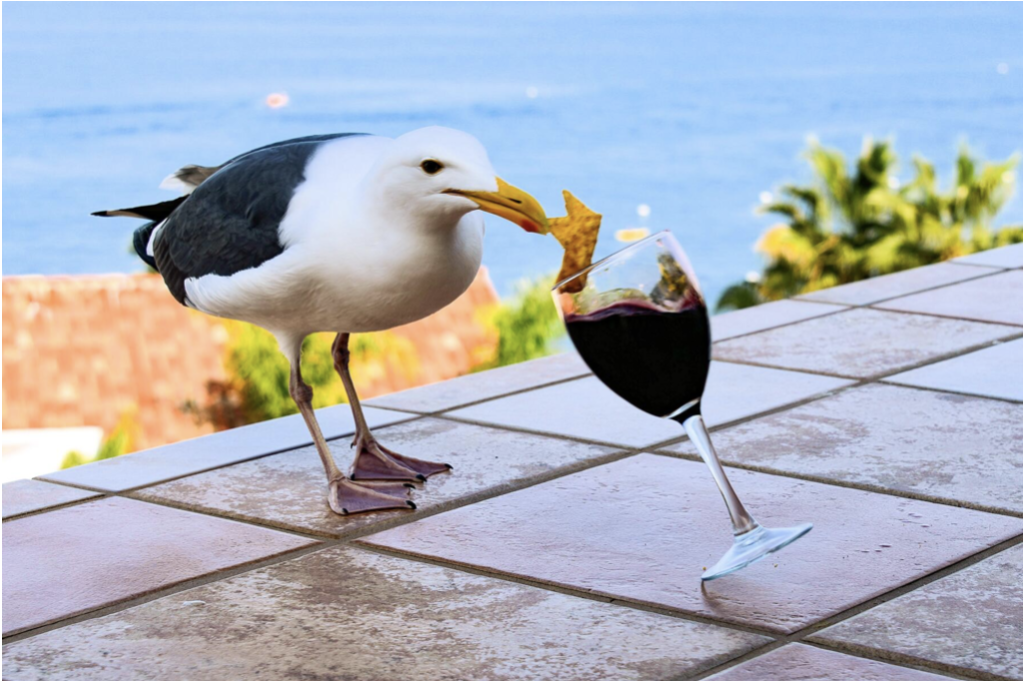
Piblokto, aka Arctic hysteria, is an Inuit syndrome where the afflicted dance wildly, tear off their clothing and roll naked on the ice; followed by amnesia. Some say it is caused by vitamin A overdose, others favour social stress. I suspect it may be caused by over-indulgence in Seagull wine although, on reflection, entry-level indulgence might be enough.
Seagull wine is allegedly made by cramming a dead seagull into a bottle of water and leaving it to ferment in the sun until it produces a vile and powerful booze, with top notes of guillemot and base notes of regret. This avian catastrophe can be brewed at home using one large or two medium dead seagulls, available at all good stores and of course on Amazon. It is a thing that the thing from the movie The Thing would sip at its Antarctic base while waiting for the Fernet-Branca to arrive (1).
Seagull wine is best served (if at all) with surströmming. To produce this Swedish delicacy, take a passel of herrings and set them aside for several months while they ferment, producing hydrogen sulphide, trimethylamine (TMA) (2) and polyamines (3, and see below). H2S is the smell of rotten eggs, TMA the smell of rotting fish, the polyamines add a whiff of death. It is an intoxicating combination.
Surströmming is banned on most airlines due to safety concerns about its pressurized, potentially explosive cans and overpowering smell. It’s illegal to open a tin of this stuff indoors in Sweden in public buildings, or on public transport. It’s not very healthy either. H2S (4) and both trimethylamine and its oxidation product TMAO (5) are cancer-promoters. Adding insult to injury, TMAO appears to increase the risk of cardiovascular disease (6).
I occasionally eat surströmming but, guided by high-functioning sociopath Bill Clinton, I try not to inhale.
In all my travels north of the Arctic Circle, however, I never once encountered seagull wine, nor a living seagull wine drinker. Nor have I eaten kiviak, Greenlands’ riposte to surströmming. As per Lady Arabella Boxer’s notorious recipe (7), ‘Take several hundred little auks (great auks are off) and stuff them, beaks, feathers, warts and all, into a seal carcass. Bury under rocks, ferment for 6 months, exhume and serve cold, preferably on imperial porcelain. Enjoy!’
The Taiwanese prepare a similar dish.
I worked in Taipei for a month, where my hosts enjoyed making me run the culinary gauntlet. It began with stuffed chicken feet, progressed to chicken sculls and fried jelly fish, and culminated in an unforgettable night of stinky tofu served with cubes of congealed pig’s blood. The stench was so intense the taxi driver insisted on dropping us off 80 meters upwind of the café.
Stinky tofu is not quite as challenging as kiviak as it smells of rotten garbage rather than rotten fish, and gains its bouquet from the polyamines spermine and spermidine, together with the related compounds putrescine and cadaverine (8).
Natto and tempeh, fermented soy foods consumed in Japan, Korea and other Far Eastern countries, are rich sources of the same compounds (9). Garum, the sauce made from fermented fish guts which the ancient Greeks and Romans added to everything (10), provides similar chemistry.
Putrescine and cadaverine are the signature scent of organic decay. They give rotting corpses a distinctive odour which, once experienced, is never forgotten. Spermine and spermidine, which occur in semen where they protect the sperm and are critical to successful fertilisation (11, 12), add musky and ammoniacal grace notes.
Why, it seems reasonable to ask, do people eat these malodorous foods? Fermentation is a legitimate way of preserving food, of course, but it turns out there is more. The polyamines stink of decay and death, yet they bring life.
Spermine and spermidine have antioxidant and (epigenetically induced) anti-inflammatory properties in humans (13, 14-16). In animal models they inhibit various age-associated pathologies (ie 17), extend lifespan (15, 16) and re-set parts of the epigenetic clock (17, 18).
Both spermine and spermidine are capable of inducing autophagy (19), a process which removes damaged and dysfunctional cells. In some models spermidine has demonstrated an additional and complementary anti-ageing effect, by reversing cellular senescence (20).
It is probably no coincidence that the legendarily healthy Mediterranean diet contains fairly high levels of polyamines (21, 22). Good sources include wheat germ and bran, soybeans and shellfish (23-25).
Ingested polyamines are directed preferentially in the body to tissues and organs that have been stimulated to grow by metabolic signals (26, and they are classified as conditionally essential nutrients (27). Endogenous synthesis may not be sufficient, for example, during periods of rapid growth and/or healing (see below).
Let us look at polyamine biochemistry in a little more detail.
The polyamines bind to DNA, RNA and messenger proteins. They stabilize DNA and RNA, helping to maintain their integrity, and are essential for protein synthesis, cell signalling and cell division, differentiation and growth (28).
They also act on the heart. By inducing strong inward rectification of the potassium channels, they make myocardium less excitable (29). They should therefore have anti-arrhythmic and cardio-protective properties, but the existing clinical data are profoundly inconsistent (30-34).
This may be a specific example of a more general case.
The overall literature indicates that polyamines play positive and protective roles in the healthy individual (ie 15), but may exacerbate existing degenerative diseases including cancer (35, 36), and neurodegenerative (37, 38) and cardiovascular (39) disease. This in turn means that the impact of polyamines at the population level must have shifted over time.
Among vestigial groups and in mid-Victorian England, ie in times and cultures where degenerative non-communicable disease was relatively rare (40, 41), the effect of dietary and endogenous polyamines must have been generally positive. In an era characterised by a profoundly unhealthy dietary shift to ultra-processed foods, with a subsequent explosion of clinical and pre-clinical degenerative disease, the impact of polyamines on public health is likely to be more negative.
Accordingly, I do not believe that polyamine supplements for all is a good idea today. However, in those cultures which produced high-octane polyamine foods such as garum, kiviak, surströmming and stinking tofu, polyamines were likely pro-health, and specifically, pro-healing.
Spermine, spermidine and putrescine (36) all promote healing by driving cell proliferation and differentiation. Given that they are induced by damaged and dying organic matter (levels of putrescine and spermidine increase almost immediately after injury (42), indicating increased protein turnover), one could consider them as components in an acute attempt by the affected organism to overcome entropy, and live.
In mechanistic terms, the polyamines play a central role in building cytoskeleton, enhancing mitochondrial function and promoting fibroblast migration. These actions would be expected to accelerate wound repair (42, 43). In the wild, and in wilder times, this made sense.
The Romans, Vikings and Samurai might not have got on well with each other – they only ever met in the video game ‘For Honour’, and a handful of Z-movies – but they did have one thing in common: hand to hand combat. They sliced and diced each other with swords, spears, arrows and axes, leaving wounds and Scars Aplenty. (My new gamer name).
When you read Caeasar’s Gallic Wars, the Norse Sagas or Tales of the Samurai, you get an impression of remarkably fast healing in those who didn’t expire on the spot. Might this have been real? And if so, did their high polyamine diet contribute to that?
I knew that the presence of trace amounts of yeast-derived beta-glucans in the unsterilized environments of our past would have improved wound healing (44). Then, while dipping into Pliny, I stumbled on a reference in Book 31 to Garum being useful for healing dog bites, burns and healing in general.
A more recent study used spermidine to accelerate wound healing in mice, and it did so whether it was applied topically or ingested (45). Pliny was right!
Finally, let us do as the Romans did, and examine the entrails.
The microbiota are deeply involved in intestinal polyamine synthesis (46), and there is evidence that probiotics upregulate spermine synthesis in various species, including humans (47-49). If probiotics do this, then prebiotics are likely to do so to an even greater extent. This interesting hypothesis is currently being explored in Japan (50).
Pliny the Elder was a great admirer of Hippocrates, who said – as everybody knows – that all illness starts in the intestines. Maybe not all, but dietary intakes of polyamines, plus a likely prebiotic / polyamine connection, look increasingly important for our overall health.
References
- Ryan Boyd wrote a very fun article for Fodor. https://www.fodors.com/news/photos/do-you-dare-drink-these-intensely-upsetting-liquors-from-around-the-world
- Belleggia L, Aquilanti L, Ferrocino I, Milanović V, Garofalo C, Clementi F, Cocolin L, Mozzon M, Foligni R, Haouet MN, Scuota S, Framboas M, Osimani A. Discovering microbiota and volatile compounds of surströmming, the traditional Swedish sour herring. Food Microbiol. 2020 Oct;91:103503.
- Biji KB, Ravishankar CN, Venkateswarlu R, Mohan CO, Gopal TK. Biogenic amines in seafood: a review. J Food Sci Technol. 2016 May;53(5):2210-8.
- Gao W, Liu YF, Zhang YX, Wang Y, Jin YQ, Yuan H, Liang XY, Ji XY, Jiang QY, Wu DD. The potential role of hydrogen sulfide in cancer cell apoptosis. Cell Death Discov. 2024 Mar 6;10(1):114.
- Yan Y, Li J, Xu H, Yang C, Li G, Feng Y, Wang Q, Li L, Wu R, Sun H, Zhang T, Wang F, Mao Y. The food-derived metabolite trimethylamine and trimethylamine-N-oxide promote colorectal cancer progression via SREBF1. Ecotoxicol Environ Saf. 2025 Sep 15;303:118996.
- Caradonna E, Abate F, Schiano E, Paparella F, Ferrara F, Vanoli E, Difruscolo R, Goffredo VM, Amato B, Setacci C, Setacci F, Novellino E. Trimethylamine-N-Oxide (TMAO) as a Rising-Star Metabolite: Implications for Human Health. Metabolites. 2025 Mar 24;15(4):220.
- https://books.google.com/books/about/Arabella_Boxer_s_Book_of_Elegant_Cooking.html?id=jFeSExmbwJgC
- Gu J, Liu T, Hou J, Pan L, Sadiq FA, Yuan L, Yang H, He G. Analysis of bacterial diversity and biogenic amines content during the fermentation processing of stinky tofu. Food Res Int. 2018 Sep;111:689-698.
- Toro-Funes N, Bosch-Fuste J, Latorre-Moratalla ML, Veciana-Nogués MT, Vidal-Carou MC. Biologically active amines in fermented and non-fermented commercial soybean products from the Spanish market. Food Chem. 2015 Apr 15;173:1119-24.
- D’Agostino A, Gismondi A, Di Marco G, Lo Castro M, Olevano R, Cinti T, Leonardi D, Canini A. Lifestyle of a Roman Imperial community: ethnobotanical evidence from dental calculus of the Ager Curensis inhabitants. J Ethnobiol Ethnomed. 2019 Dec 4;15(1):62.
- Singh BP, Saha I, Nandi I, Swamy MJ. Spermine and spermidine act as chemical chaperones and enhance chaperone-like and membranolytic activities of major bovine seminal plasma protein, PDC-109. Biochem Biophys Res Commun. 2017 Dec 2;493(4):1418-1424.
- Bauer MA, Carmona-Gutiérrez D, Ruckenstuhl C, Reisenbichler A, Megalou EV, Eisenberg T, Magnes C, Jungwirth H, Sinner FM, Pieber TR, Fröhlich KU, Kroemer G, Tavernarakis N, Madeo F. Spermidine promotes mating and fertilization efficiency in model organisms. Cell Cycle. 2013 Jan 15;12(2):346-52.
- Soda K., Uemura T., Sanayama H., Igarashi K., Fukui T. Polyamine-Rich Diet Elevates Blood Spermine Levels and Inhibits Pro-Inflammatory Status: An Interventional Study. Med. Sci. 2021;9:22.
- Soda K., Kano Y., Nakamura T., Kasono K., Kawakami M., Konishi F. Spermine, a natural polyamine, suppresses LFA-1 expression on human lymphocyte. J. Immunol. 2005;175:237–245.
- Soda K., Kano Y., Chiba F., Koizumi K., Miyaki Y. Increased polyamine intake inhibits age-associated alteration in global DNA methylation and 1,2-dimethylhydrazine-induced tumorigenesis. PLoS ONE. 2013;8:e64357.
- Ito D, Ito H, Ideta T, Kanbe A, Ninomiya S, Shimizu M. Systemic and topical administration of spermidine accelerates skin wound healing. Cell Commun Signal. 2021 Mar 22;19(1):36.
- Kano Y., Soda K., Konishi F. Suppression of LFA-1 expression by spermine is associated with enhanced methylation of ITGAL, the LFA-1 promoter area. PLoS ONE. 2013;8:e56056.
- Fukui T., Soda K., Takao K., Rikiyama T. Extracellular Spermine Activates DNA Methyltransferase 3A and 3B. Int. J. Mol. Sci. 2019;20:1254.
- Eisenberg T, Abdellatif M, Schroeder S, Primessnig U, Stekovic S, Pendl T, Harger A, Schipke J, Zimmermann A, Schmidt A, Tong M, Ruckenstuhl C, Dammbrueck C, Gross AS, Herbst V, Magnes C, Trausinger G, Narath S, Meinitzer A, Hu Z, Kirsch A, Eller K, Carmona-Gutierrez D, Büttner S, Pietrocola F, Knittelfelder O, Schrepfer E, Rockenfeller P, Simonini C, Rahn A, Horsch M, Moreth K, Beckers J, Fuchs H, Gailus-Durner V, Neff F, Janik D, Rathkolb B, Rozman J, de Angelis MH, Moustafa T, Haemmerle G, Mayr M, Willeit P, von Frieling-Salewsky M, Pieske B, Scorrano L, Pieber T, Pechlaner R, Willeit J, Sigrist SJ, Linke WA, Mühlfeld C, Sadoshima J, Dengjel J, Kiechl S, Kroemer G, Sedej S, Madeo F. Cardioprotection and lifespan extension by the natural polyamine spermidine. Nat Med. 2016 Dec;22(12):1428-1438.
- Zhang H, Alsaleh G, Feltham J, Sun Y, Napolitano G, Riffelmacher T, Charles P, Frau L, Hublitz P, Yu Z, Mohammed S, Ballabio A, Balabanov S, Mellor J, Simon AK. Polyamines Control eIF5A Hypusination, TFEB Translation, and Autophagy to Reverse B Cell Senescence. Mol Cell. 2019 Oct 3;76(1):110-125.e9.
- Soda K., Kano Y., Chiba F. Food polyamine and cardiovascular disease—An epidemiological study. Glob. J. Health Sci. 2012;4:170–178.
- Binh P.N.T., Soda K., Kawakami M. Mediterranean diet and polyamine intake: Possible contribution of increased polyamine intake to inhibition of age-associated disease. Nutr. Diet. Suppl. 2011;3:1–7.
- Cipolla B.G., Havouis R., Moulinoux J.P. Polyamine contents in current foods: A basis for polyamine reduced diet and a study of its long-term observance and tolerance in prostate carcinoma patients. Amino Acids. 2007;33:203–212.
- Nishibori N., Fujihara S., Akatuki T. Amounts of polyamines in foods in Japan and intake by Japanese. Food Chem. 2006;100:491–497.
- Soda K., Mogi S., Shiina M., Kawabata N. The Polyamine Content in Various Foods on a Calorie Basis. Jacobs J. Food Nutr. 2017;4:029.
- Bardoscz S, Grant G, Brown DS, Ralph A, Pusztai A. Polyamines in food—implications for growth and health. (1993) J Nut Biochem. 4(2), 66-71
- Löser C, Eisel A, Harms D, Fölsch UR. Dietary polyamines are essential luminal growth factors for small intestinal and colonic mucosal growth and development. Gut. 1999 Jan;44(1):12-6.
- Sagar NA, Tarafdar S, Agarwal S, Tarafdar A, Sharma S. Polyamines: Functions, Metabolism, and Role in Human Disease Management. Med Sci (Basel). 2021 Jun 9;9(2):44.
- Nichols CG, Makhina EN, Pearson WL, Sha Q, Lopatin AN. Inward rectification and implications for cardiac excitability. Circ Res. 1996 Jan;78(1):1-7.
- Goni L, Razquin C, Toledo E, Guasch-Ferré M, Clish CB, Babio N, Wittenbecher C, Atzeni A, Li J, Liang L, Dennis C, Alonso-Gómez Á, Fitó M, Corella D, Gómez-Gracia E, Estruch R, Fiol M, Lapetra J, Serra-Majem L, Ros E, Arós F, Salas-Salvadó J, Hu FB, Martínez-González MA, Ruiz-Canela M. Arginine catabolism metabolites and atrial fibrillation or heart failure risk: 2 case-control studies within the Prevención con Dieta Mediterránea (PREDIMED) trial. Am J Clin Nutr. 2022 Sep 2;116(3):653-662.
- Eisenberg T, Abdellatif M, Schroeder S, Primessnig U, Stekovic S, Pendl Tet al. Cardioprotection and lifespan extension by the natural polyamine spermidine. Nat Med. 2016;22(12):1428–38.
- Soda K, Kano Y, Chiba F.. Food polyamine and cardiovascular disease–an epidemiological study. Glob J Health Sci. 2012;4(6):170–8.
- Morena-Manuel AI, Cruz FM, Macias A, Carera-Borrego E, Jalife J. Repurposing polyamines to prevent arrhythmias in Short QT Syndrome type 3, a potentially lethal disease. BioRxiv https://doi.org/10.1101/2025.09.10.675300
- Meana C, Rubín JM, Bordallo C, Suárez L, Bordallo J, Sánchez M. Correlation between endogenous polyamines in human cardiac tissues and clinical parameters in patients with heart failure. J Cell Mol Med. 2016 Feb;20(2):302-12. doi: 10.1111/jcmm.12674.
- Holbert CE, Cullen MT, Casero RA Jr, Stewart TM. Polyamines in cancer: integrating organismal metabolism and antitumour immunity. Nat Rev Cancer. 2022 Aug;22(8):467-480.
- Farriol M, Segovia-Silvestre T, Castellanos JM, Venereo Y, Orta X. Role of putrescine in cell proliferation in a colon carcinoma cell line. Nutrition. 2001 Nov-Dec;17(11-12):934-8.
- LeWitt PA, Hong L, Patil R. Polyamine Biomarkers of Parkinson’s Disease Progression. Mov Disord 2022; 37:S16-S17.
- Brooks WH. Polyamine Dysregulation and Nucleolar Disruption in Alzheimer’s Disease. J Alzheimers Dis. 2024;98(3):837-857.
- Chen Z, Wang S, Liu L, Yin L, Xu X, Xiong J, Zhao J. Association of Serum Polyamines with Cardiovascular Events and All-Cause Mortality in Chronic Kidney Disease. Cardiorenal Med. 2025;15(1):238-248.
- Eaton SB, Konner M, Shostak M. Stone agers in the fast lane: chronic degenerative diseases in evolutionary perspective. Am J Med. 1988 Apr;84(4):739-49.
- Clayton P, Rowbotham J. How the mid-Victorians worked, ate and died. Int J Environ Res Public Health. 2009 Mar;6(3):1235-53.
- Jeevanandam M, Ali MR, Young DH, Schiller WR. Polyamine levels as biomarkers of injury response in polytrauma victims. Metabolism. 1989 Jul;38(7):625-30.
- Lim HK, Rahim AB, Leo VI, Das S, Lim TC, Uemura T, Igarashi K, Common J, Vardy LA. Polyamine Regulator AMD1 Promotes Cell Migration in Epidermal Wound Healing. J Invest Dermatol. 2018 Dec;138(12):2653-2665.
- Cairns CA, Chen T, Han N, Chen H, Chung HK, Xiao L, Wang JY. Polyamines regulate mitochondrial metabolism essential for intestinal epithelial renewal and wound healing. Am J Physiol Gastrointest Liver Physiol. 2025 Jul 1;329(1):G191-G200.
- Ito D, Ito H, Ideta T, Kanbe A, Ninomiya S, Shimizu M. Systemic and topical administration of spermidine accelerates skin wound healing. Cell Commun Signal. 2021 Mar 22;19(1):36.
- Kibe R, Kurihara S, Sakai Y, Suzuki H, Ooga T, Sawaki E, Muramatsu K, Nakamura A, Yamashita A, Kitada Y, Kakeyama M, Benno Y, Matsumoto M. Upregulation of colonic luminal polyamines produced by intestinal microbiota delays senescence in mice. Sci Rep. 2014 Apr 1;4:4548.
- Matsumoto M, Ohishi H, Benno Y. Impact of LKM512 yogurt on improvement of intestinal environment of the elderly. FEMS Immunol Med Microbiol. 2001 Oct;31(3):181-6.
- Matsumoto M, Kurihara S, Kibe R, Ashida H, Benno Y. Longevity in mice is promoted by probiotic-induced suppression of colonic senescence dependent on upregulation of gut bacterial polyamine production. PLoS One. 2011;6(8):e23652.
- Bui TI, Britt EA, Muthukrishnan G, Gill SR. Probiotic induced synthesis of microbiota polyamine as a nutraceutical for metabolic syndrome and obesity-related type 2 diabetes. Front Endocrinol (Lausanne). 2023 Jan 13;13:1094258.
- Yu L, Pan J, Guo M, Duan H, Zhang H, Narbad A, Zhai Q, Tian F, Chen W. Gut microbiota and anti-aging: Focusing on spermidine. Crit Rev Food Sci Nutr. 2024;64(28):10419-10437.