My Left Foot
On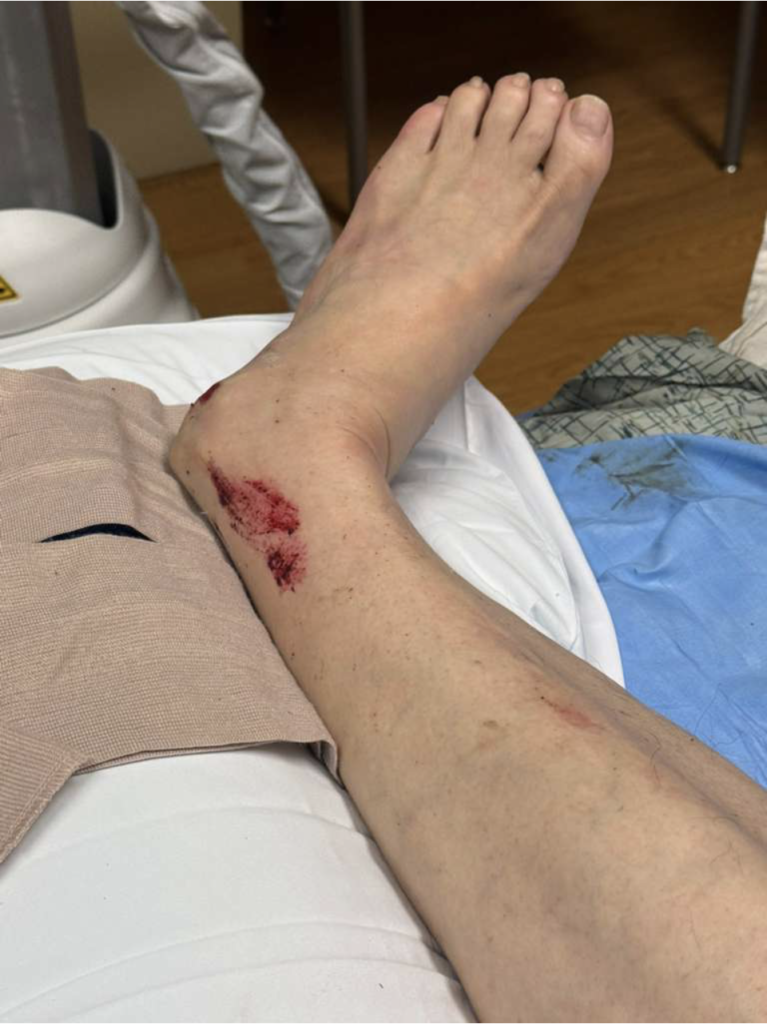
May 28th was a good day for me, I survived a potentially fatal accident. Some of the results are in the photo, above, where the expert eye might see not only the obvious dislocation but also a fracture of the talus, which snapped clean in two.
The talus is one of those many pieces of the anatomy you tend not to miss until it’s gone. It is the universal joint that transmits load from the lower limb to the foot, where it permits both pitch and yaw. Without it I must currently crawl where I once ran, and use crutches to negotiate the yawning chasms between bed and breakfast, desk and doorway.
A good surgeon fixed the talus back in place with a titanium plate, and I won’t be able to put my foot down for at least 8 weeks. But the point of this article is not to bemoan my luck – in fact, quite the opposite.
Nutritionally inclined scientists often use themselves as guinea pigs because, among other reasons, it’s easier and quicker than negotiating with ethics committees. I have long experimented with different versions of the health protocol, starting many years before it became commercial. This meant that when my leg and various other parts of me went through the mangle, I was in metabolically good shape.
Specifically, I was not in the generally pro-inflammatory mode that the modern diet and lifestyle encourage. My regimen (the current health protocol) permitted and in some ways enhanced acute inflammation, while militating against chronic inflammation. My innate immune system was in good shape, I was in eubiosis. And it all paid off.
The 0edema after injury is an acute inflammatory response. Considering the severity of the injury, I experienced minimal oedema. The short- to medium-term pain after injury is largely mediated by an inflammatory response, and here too I was remarkably untouched. I experienced relatively little pain and was able to carry out a coherent conversation until the paramedics arrived. As per policy they gave me a strong opiate, probably fentanyl, and took me to the local orthopaedic trauma unit.
The trauma team reduced the fracture under general sedation – thankfully – and sent me home with oxycodone. I took 10 mg, and fell asleep. I took 10 mg the following day and stopped altogether on day 3.
Over the last week I have mostly used ibuprofen, starting with 1200 mg / day and dropping within 4 days to 200 mg. Some residual swelling, little pain except when I jog my foot. The talus is stabilised, bandages thrown away, all surface wounds healed, no sign of infection.
The full RICE protocol of rest, ice, compression and elevation was reduced to rest and 5 days of mild compression. A prolonged course of opiates was not needed. Neither were antibiotics, anti-diabetics, proton pump inhibitors, blood thinners, treatments for bedsores, laxatives, diuretics, calcium, vitamin D – or anything else.
I cannot yet put weight on the damaged foot, or travel, but will be scanned on the 18th. Superficial healing is clean and advanced, and I am confident that the fracture will have started to heal.
At age 75 this is not a typical pattern of recovery, but it is what I anticipated. I have not experienced chronic hyper-inflammation, which impedes wound recovery (1), nor do I expect to. My innate immune system is working well (2), and it is likely that my thymus remains functional also (3). My vascular endothelium is quiescent (4), my glycemic control in order (5), all relevant anabolic co-factors are in place, and I don’t smoke.
The photo (below) shows rapid wound healing 6 days after surgery, a process which represents one of many components in successful ageing (6).
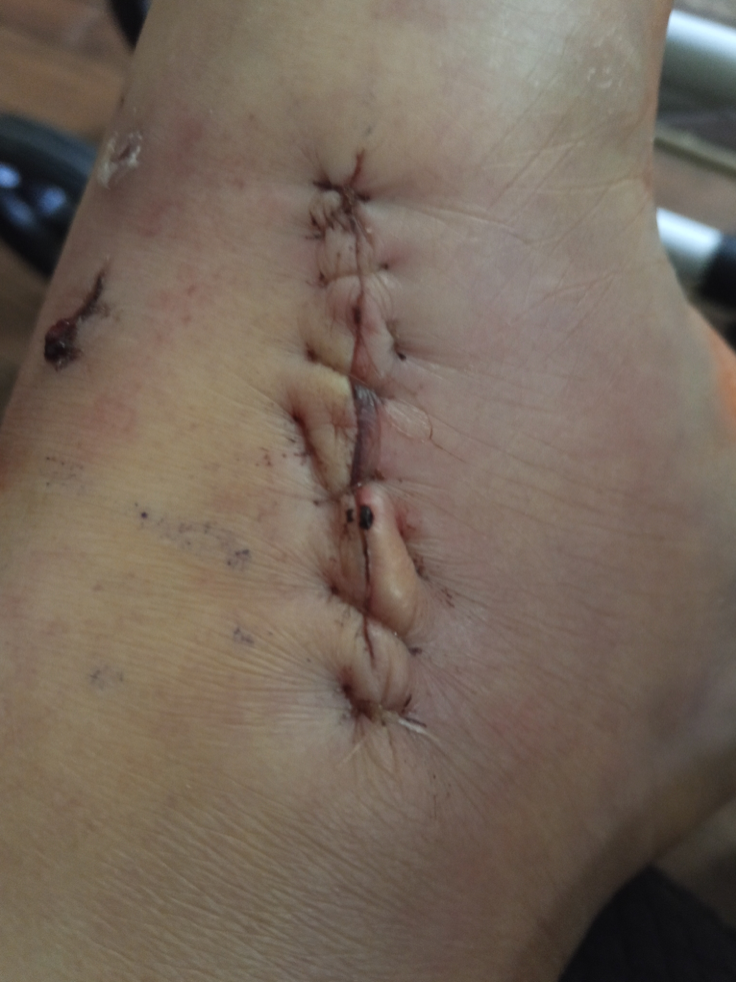
The surgeon, an excellent man, has clearly not specialized in needlepoint.
My posts and other writings are generally critical of the foundations and praxis of modern healthcare, but I have nothing but respect for frontline responders and accident and emergency medicine. These are the great triumphs of 20th and 21st century medicine.
In secondary through quaternary healthcare, however, the emphasis remains stuck on reactive medicine. If primary healthcare (and wider society) were to include pharmaconutrition in their approach, all elective patients could be nutritionally prepped, and the nutritional profile of the general population improved. Hospital costs, complications and unnecessary deaths would be dramatically reduced.
Based on pre-transitional health data, extensive rectification of the national diet and a return to pre-transitional nutritional values should reduce chronic degenerative disease by up to 90% (7).
Within the USA, 90% of the nation’s $5.3 trillion in annual health care expenditures are for people with chronic and mental health conditions (8, 9). Systemic improvement of the national nutritional profile would therefore create savings of up to $4.3 trillion.
In the UK, caring for people with long-term or chronic health conditions accounts for approximately 70% of the total health and social care budget, corresponding to roughly £145 billion annually (10). If we could reduce this by 90% the resulting savings would be in the region of £130 billion.
These figures cannot be entirely correct because even if we can prevent the majority of chronic diseases, people will still become infirm and dependent at the end of life. So let us round the savings down by approximately 1/3 – I’m being conservative – to $3 trillion and £100 billion respectively. These are enormous sums, and on June 8th Robert Kennedy Jr set out to realize them.
Under the government’s voluntary “Make American Healthy Again” framework, Kennedy urged medical schools to require a minimum of 40 hours of formal nutrition education, or a competency equivalent (11).
73 medical schools committed, including some of the most eminent (12), with others pending. Approximately 15% of content across all three steps of the U.S. Medical Licensing Examination (USMLE) will now assess evidence-based nutrition and clinical application (13). Starting from fall 2026, thousands of future doctors will undergo enhanced training (13).
The potential return on investment is staggering, and the scale of lost profit to the pharmaceutical and health insurance industries equally so. Given the regularity with which US (and euro-) politicians are bought and sold, one wonders whether this initiative or Kennedy will end first; but if public approval for the core concept remains high, it may be difficult to push this ratchet back.
As a long-time proponent of test-based pharmaconutrition, I see this as a critical step towards better public health and reduced dependence on crisis-management medicine.
Let’s put our best foot forward.
References:
- Holzer-Geissler JCJ, Schwingenschuh S, Zacharias M, Einsiedler J, Kainz S, Reisenegger P, Holecek C, Hofmann E, Wolff-Winiski B, Fahrngruber H, Birngruber T, Kamolz LP, Kotzbeck P. The Impact of Prolonged Inflammation on Wound Healing. Biomedicines. 2022 Apr 6;10(4):856.
- https://drpaulclayton.eu/blog/innately-trained/
- https://drpaulclayton.eu/blog/1614/
- https://drpaulclayton.eu/blog/in-vein/
- https://drpaulclayton.eu/blog/an-exercise-in-bureaucracy/
- Khalid KA, Nawi AFM, Zulkifli N, Barkat MA, Hadi H. Aging and Wound Healing of the Skin: A Review of Clinical and Pathophysiological Hallmarks. Life (Basel). 2022 Dec 19;12(12):2142.
- Clayton P, Rowbotham J. How the mid-Victorians worked, ate and died. Int J Environ Res Public Health. 2009 Mar;6(3):1235-53.
- Buttorff C, Ruder T, Bauman M. Multiple Chronic Conditions in the United States. Rand Corp.; 2017.
- National health expenditure data: historical. Center for Medicare & Medicaid Services. Updated January 14, 2026. Accessed May 7, 2026. https://www.cms.gov/data-research/statistics-trends-and-reports/national-health-expenditure-data/historical
- Nuffield Trust. Care & Support for Long-term conditions. 25.02.26, https://www.nuffieldtrust.org.uk/resource/care-and-support-for-long-term-conditions
- https://www.hhs.gov/press-room/secretary-kennedy-announces-historic-development-nutrition-accreditation-standards-new-medical-school-pledges.html
- https://med.stanford.edu/school/leadership/dean/precision-health-in-the-news/why-medica-schools-need-focus-nutrition.html
- https://www.youtube.com/watch?v=2zi9x8y9yug&t=435s